OsteoHealthBlog

A brief tour of the minnow

Eine Schwarz-Weiß-Zeichnung eines Auges mit sportosteopathischen Elementen.
A brief tour of the minnow

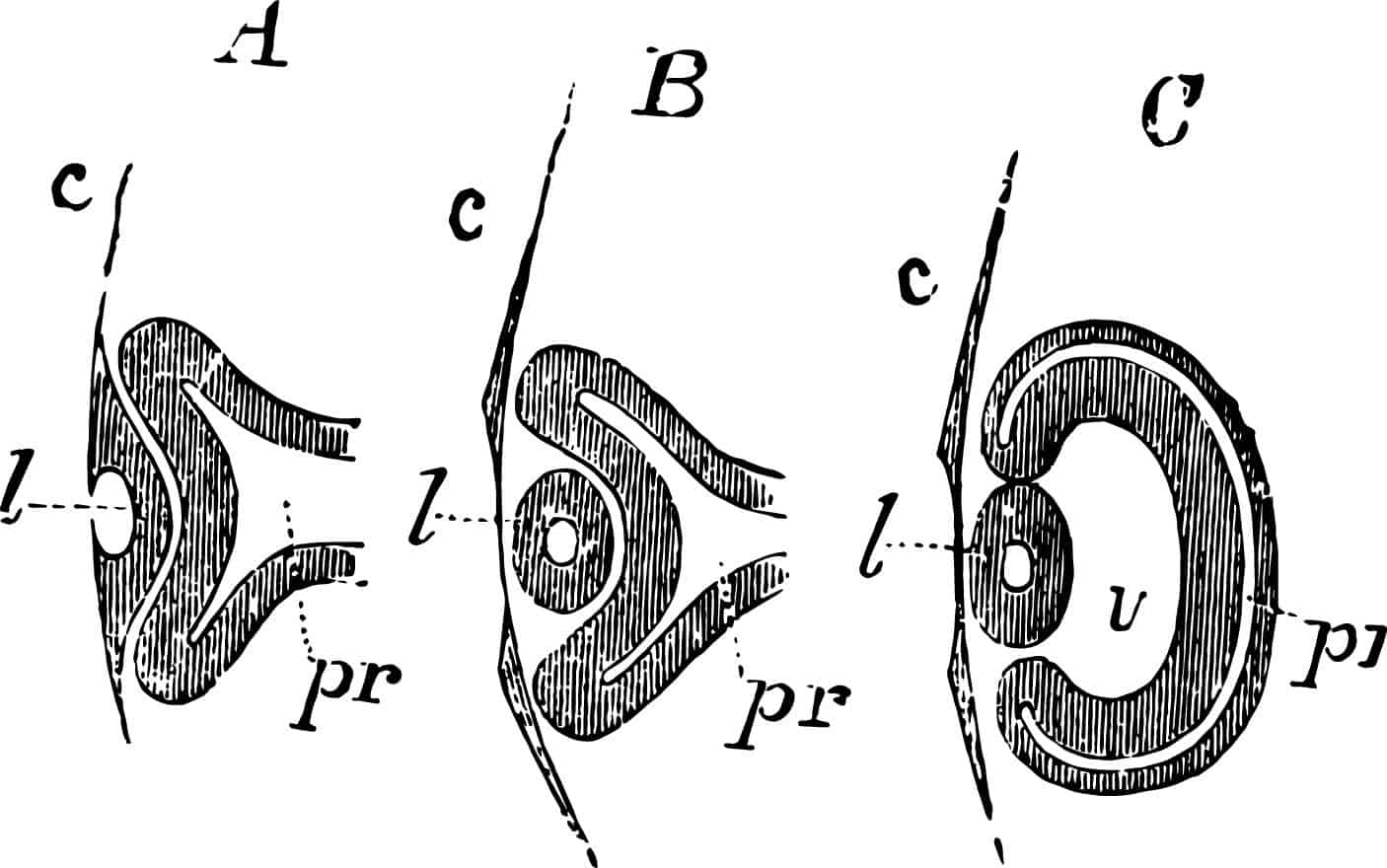
On various occasions at the end of a course on the cranial concept, Sutherland liked to hold a lecture entitled “A tour of the minnow.”8 The underlying idea was to illustrate insights into and about the living brain. I adopted Sutherland’s idea, and we will accompany the minnow on a sightseeing tour to the period when the eye is being formed. This description will serve as an example of fluid developmental dynamics. By palpation using gentle and meaningful hand contact, you can attempt to follow these developmental dynamics: 

  • The minnow finds itself in the primary forebrain. 
  • It observes how the primordium of the eye appears on day 25/26 (at a time when the neural tube has not yet closed) as a small groove (the optic sulcus) on the forebrain. 
  • It accompanies this development further and notes how this groove rapidly deepens and how, following closure of the neural tube, the tiny optic vesicle appears as a projection of the primary forebrain. 
  • The minnow attentively observes how the optic vesicle in its further growth dynamics reaches toward the external boundary of the body on about day 32 and finally touches it. 
  • As soon as it touches the epidermis, the optic vesicle flattens and undergoes indentation to form the optic cup. The minnow witnesses a repeat of developmental dynamic movements similar to those leading to the formation of the neural tube. 
  • At this point of contact with the outer body surface something else occurs. The minnow again notices how the initially flat epidermal cells become columnar, and undergo condensation and invagination. This developmental dynamic is similar to gastrulation and neurulation. The optic vesicle is pressed in by the future lens material and yields around it. 
  • The minnow accompanies the lens on its inward migration until this finally detaches from the skin surface. (The process is similar to the formation of the neural tube from the neural plate, except that in this instance a circular rather than a cylindrical basic form develops.) 
  • On about day 40 the lens is surrounded by the optic cup that has formed. 
  • On the inner surface of the retina the cell layer has developed to form neurons, the axons of which grow across the inner surface of the retina and finally into the optic stalk. The minnow allows itself to be carried to an outlet for the stream carrying it, to the exit point for the optic nerve, and reaches the midbrain where the axons spread into the midbrain roof. 
  • Finally, the minnow emerges in the central fovea, as if carried along by the current of a stream. 

Bruxismus und Osteopathie

Bruxismus äußert sich durch Zähnepressen oder -knirschen im Wachzustand oder im Schlaf und kann vielfältige Ursachen haben – von Stress bis zu neurophysiologischen Faktoren. Der Beitrag beleuchtet Hintergründe, Diagnostik und osteopathische Behandlungsansätze sowie praktische Selbsthilfetechniken zur Entlastung des craniomandibulären Systems.

Artikel Lesen

Heilende Hände

Die Osteopathie gehört zu den beliebtesten komplementären Heilmethoden und betrachtet den Körper als ein verbundenes System aus Knochen, Faszien, Organen und Flüssigkeitsströmen. Mit präziser Berührung erkennt der Osteopath Spannungen, Funktionsstörungen und Blockaden – und setzt sanfte Impulse, um die Selbstheilung des Körpers zu aktivieren. Der Artikel zeigt, wie Osteopathie funktioniert, bei welchen Beschwerden sie helfen kann und welche wissenschaftlichen Erkenntnisse es heute dazu gibt.

Artikel Lesen

Interview

In der Schulmedizin existiert die psychosomatische Medizin als eigenes Fachgebiet bereits seit den 30er Jahren des letzten Jahrhunderts. Warum ist eine Psychosomatische Osteopathie nicht schon früher entwickelt worden?…

Artikel Lesen

Fallbericht einer psychosomatischen Osteopathie

Ätiologische Faktoren, Risikofaktoren und Wirkmechanismen von Beschwerden, Heilreaktionen und somato-physiologische Erlebnis-Kontext-Dysfunktionsmuster kennzeichnen die spezifischen Behandlungsansätze im Rahmen der psychosomatischen Osteopathie (PSO). Das Fallbeispiel eines Sportlers, der Leistungseinbußen zu beklagen hat, soll das therapeutische Prinzip der PSO exemplarisch vorstellen.

Artikel Lesen

Psychosomatische Osteopathie

Dieser Artikel gibt eine Übersicht über das spezifische Denken und Handeln in der psychosomatischen Osteopathie (PSO) im Allgemeinen und des Buches „Psychosomatische Osteopathie“ von Torsten Liem im Besonderen…

Artikel Lesen

MEHR ARTIKEL

In diesem Gespräch geht es um die Vergangenheit, Gegenwart und Zukunft der Osteopathie. Es wird die Evolution der Osteopathie sowie deren Konzepte, Ansätze und Techniken ...
Torsten Liem wurde zu den Wirkmechanismen in der Osteopathie interviewt. In diesem Interview geht es um die osteopathische Berührung, die Empathie und die Kognition in ...
Inhaltsverzeichnis Was bedeutet Meditation? Meditation ist ein Überbegriff für viele verschiedene Geistesübungen, welche seit Jahrtausenden in unterschiedlichen religiösen Traditionen praktiziert werden. Meditation ist insbesondere im ...
Osteohealth Newsletter

Abonnieren Sie unseren Newsletter

Wir versenden in regelmäßigen Abständen einen Newsletter mit Videos, Podcasts und Artikeln zum Thema Gesundheit.

Wir rufen Sie zurück!

Wann dürfen wir Sie zurückrufen?*
Zu welcher Uhrzeit?*